
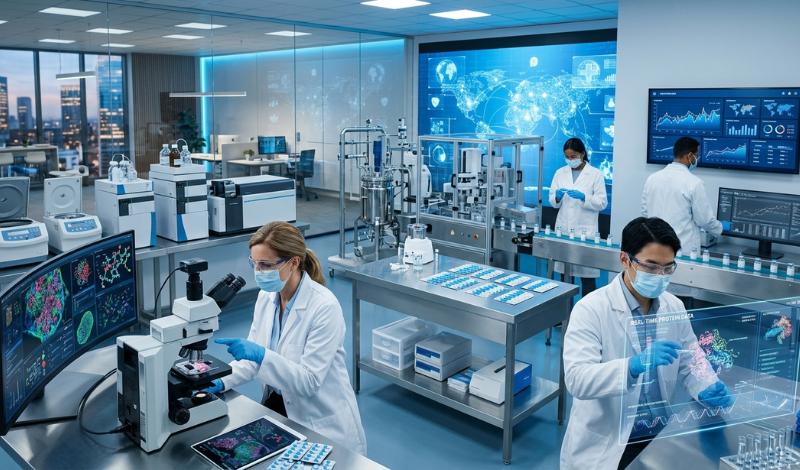
Quick Answer
The pharmaceutical industry is evolving rapidly as technology, scientific research, advanced manufacturing, and changing healthcare needs reshape how medicines are developed and delivered. Modern pharmaceutical businesses are increasingly adopting digital systems, automation, advanced analytics, and patient-focused approaches to improve efficiency, quality, and accessibility.
These developments are creating a more connected healthcare ecosystem where manufacturers, distributors, healthcare providers, and patients can work together more effectively. Innovation across manufacturing and distribution can also help pharmaceutical organisations respond to supply chain challenges, regulatory requirements, and growing global demand for medicines.
Why innovation matters in healthcare
- Supports the development of improved medicines and treatment solutions.
- Enhances pharmaceutical manufacturing efficiency.
- Improves quality control and operational monitoring.
- Strengthens medicine distribution and supply chain visibility.
- Supports patient-focused healthcare solutions.
- Helps pharmaceutical businesses respond to changing market requirements.
- Encourages the adoption of advanced technologies across healthcare.
Successful innovation requires more than technology alone. Pharmaceutical organisations must combine innovation with quality systems, regulatory compliance, skilled professionals, reliable infrastructure, and a strong understanding of patient and healthcare requirements.
Understanding Healthcare Innovation and Its Role in Modern Pharmaceuticals
The pharmaceutical sector is experiencing significant changes as healthcare innovation influences drug discovery, manufacturing, diagnostics, distribution, and patient care. New technologies are helping pharmaceutical organisations improve how they manage complex processes while creating opportunities for more efficient and responsive healthcare systems.
Artificial intelligence and machine learning are being explored in areas such as drug discovery, clinical research, data analysis, and pharmaceutical quality management. These technologies can process large volumes of information and support researchers and healthcare professionals in making data-driven decisions.
Automation is also transforming pharmaceutical manufacturing. Automated production systems, robotics, digital monitoring, and advanced laboratory technologies can reduce repetitive manual processes and improve consistency. When appropriately validated and monitored, these systems can support better process control and operational efficiency.
Other important areas of innovation include:
- Artificial intelligence and machine learning
- Automated pharmaceutical manufacturing
- Digital quality management systems
- Advanced drug delivery technologies
- Connected healthcare devices
- Predictive analytics
- Digital health platforms
- Advanced analytical testing
Innovation must be implemented responsibly, particularly within the highly regulated pharmaceutical sector. New technologies need appropriate validation, cybersecurity controls, employee training, and regulatory oversight to ensure that improvements in efficiency do not compromise product quality or patient safety.
How Modern Technologies Are Strengthening the Medicine Supply Chain
The movement of pharmaceutical products from manufacturing facilities to healthcare providers involves multiple stages, including storage, transportation, inventory management, documentation, and distribution. A reliable medicine supply chain is essential for ensuring that pharmaceutical products reach their intended destinations safely and efficiently.
Digital technologies are providing greater visibility across these processes. Inventory management systems can help organisations monitor stock levels, while tracking technologies can provide information about shipments as they move through different distribution stages.
Temperature monitoring is particularly important for medicines that require controlled storage conditions. Connected sensors and digital monitoring systems can help identify temperature deviations during storage and transportation, allowing organisations to respond to potential risks more quickly.
Modern supply chain technologies can support:
- Real-time shipment tracking
- Digital inventory management
- Temperature monitoring
- Product traceability
- Automated documentation
- Demand forecasting
- Distribution planning
- Supply chain risk management
A strong supply chain also requires appropriate contingency planning. Delays, transportation disruptions, changes in demand, regulatory requirements, and other unexpected events can affect pharmaceutical distribution.
By combining technology with qualified logistics partners, robust documentation, quality procedures, and risk management systems, pharmaceutical organisations can improve supply chain resilience and maintain more reliable access to medicines.
The Changing Role of Pharmaceutical Businesses in Global Healthcare
The role of pharmaceutical companies extends beyond manufacturing medicines. Organisations operating in today’s global healthcare environment are increasingly expected to support quality, innovation, regulatory compliance, responsible supply, and patient-focused solutions.
Companies involved in pharmaceutical manufacturing and distribution need to maintain consistent quality standards while adapting to changing healthcare requirements. This includes investing in manufacturing infrastructure, quality control systems, research capabilities, employee development, and supply chain management.
Global pharmaceutical markets also require businesses to understand the regulatory and documentation requirements of different countries. Exporting medicines may involve product registration, certificates, quality documentation, packaging requirements, and import regulations specific to the destination market.
Key areas of focus for modern pharmaceutical businesses include:
- Quality-focused pharmaceutical manufacturing
- Regulatory compliance
- Research and development
- International pharmaceutical exports
- Advanced quality control
- Supply chain management
- Product traceability
- Patient-centered solutions
The ability to combine scientific expertise with modern technology can help pharmaceutical organisations remain competitive while maintaining the standards expected by healthcare providers and patients.
As global healthcare requirements continue to evolve, pharmaceutical businesses that focus on reliability, transparency, quality, and innovation can build stronger relationships with healthcare markets around the world.
India’s Growing Role in Pharmaceutical Manufacturing and Global Supply
India has developed a strong reputation as an important pharmaceutical manufacturing and export hub. The country’s established manufacturing capabilities, skilled workforce, extensive product portfolio, and growing international presence have contributed to its role in global medicine supply.
Technological development is further strengthening India’s pharmaceutical sector. Modern production equipment, automated systems, advanced analytical technologies, digital quality management platforms, and improved supply chain infrastructure are helping manufacturers improve operational efficiency and product consistency.
Contract manufacturing is another important area supporting the pharmaceutical ecosystem. Businesses can work with specialised manufacturing partners to produce medicines according to agreed quality, formulation, packaging, and regulatory requirements.
When selecting a manufacturing partner, pharmaceutical businesses should consider factors such as:
- Manufacturing infrastructure and capacity
- Quality management systems
- Regulatory compliance
- Product development capabilities
- Quality control and testing facilities
- Production expertise
- Documentation and traceability
- Export experience
India’s growing pharmaceutical capabilities can support both domestic healthcare requirements and international medicine supply. Continued investment in manufacturing technology, workforce development, research, and quality systems can further strengthen India’s contribution to global pharmaceutical markets.
Preparing the Pharmaceutical Industry for the Future
The future of pharmaceuticals will depend on the industry’s ability to balance innovation with quality, affordability, accessibility, and regulatory responsibility. Technology will continue to influence drug development, manufacturing, distribution, and patient engagement, but successful transformation will require strategic implementation.
Artificial intelligence, automation, connected systems, advanced analytics, and digital platforms can create significant opportunities. However, pharmaceutical organisations must carefully evaluate each technology based on its practical value, regulatory requirements, infrastructure needs, and potential impact on quality.
Workforce development will also remain important. Employees need appropriate training to operate modern manufacturing systems, manage digital platforms, interpret data, and follow updated quality procedures.
Future-focused pharmaceutical businesses should prioritize:
- Investment in reliable manufacturing technologies
- Continuous employee training
- Strong quality management systems
- Data security and cybersecurity
- Supply chain resilience
- Regulatory preparedness
- Patient-focused product development
- Sustainable operational practices
Innovation should ultimately support better healthcare outcomes rather than technology adoption for its own sake. Pharmaceutical organisations that combine modern capabilities with strong quality and regulatory foundations will be better positioned to respond to future healthcare challenges.
Frequently Asked Questions (FAQ)
What is healthcare innovation in the pharmaceutical industry?
Healthcare innovation involves applying new technologies, scientific developments, processes, and approaches to improve medicine development, manufacturing, distribution, healthcare delivery, and patient outcomes.
Why is a reliable pharmaceutical supply chain important?
A reliable supply chain helps ensure medicines are stored, transported, and distributed properly while supporting product availability, traceability, quality, and timely delivery.
How is technology changing pharmaceutical manufacturing?
Technology is improving manufacturing through automation, digital monitoring, advanced analytical systems, predictive maintenance, data-driven processes, and electronic quality management.
What should businesses consider when choosing a pharmaceutical manufacturing partner?
Businesses should evaluate manufacturing capabilities, quality systems, regulatory compliance, production capacity, testing facilities, documentation, product expertise, and international market experience.
Why is India important to the global pharmaceutical industry?
India has established significant pharmaceutical manufacturing and export capabilities, supported by its manufacturing infrastructure, skilled workforce, broad medicine portfolio, and growing international market presence.
The pharmaceutical industry is moving towards a more connected and technology-driven future where innovation, manufacturing expertise, supply chain reliability, and patient needs are increasingly interconnected. Advances in digital technologies, automation, analytics, and modern manufacturing systems are creating opportunities to improve pharmaceutical quality and operational efficiency.
India’s continued investment in technology, manufacturing infrastructure, research, quality systems, and international capabilities can further strengthen its contribution to global healthcare. The ability of a pharmaceutical contract manufacturer in India to combine advanced manufacturing capabilities with strong quality standards, regulatory compliance, and reliable production processes will remain important as global demand for safe and effective medicines continues to grow.